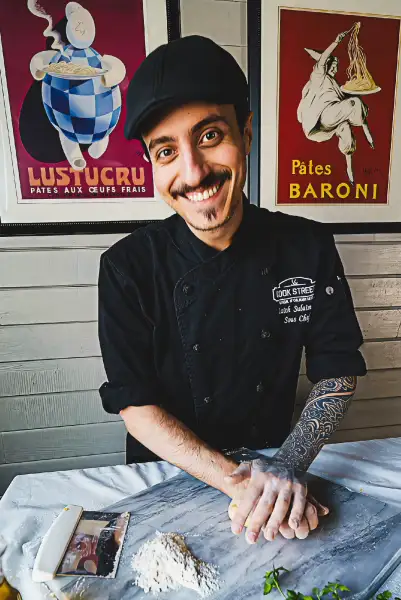


Our founder sat where you’re sitting.
Cook Street was founded in 1999 by a former attorney who found a second life through cooking. Since then, we’ve trained hundreds of career-changers in Denver’s Golden Triangle: marketers, engineers, teachers, and finance professionals who were excellent home cooks and wanted to find out, once and for all, whether they could do it professionally.
The answer, for most of them, took 16 weeks. Not two years and not $40,000.
One price. Everything in it.
Your $19,500 tuition is genuinely all-inclusive:
- ✓ French and Italian classical technique — the fundamentals our curriculum is built on
- ✓ Pastry training built into the core program
- ✓ ServSafe® Certification — the food-safety credential employers require
- ✓ Your knife kit, uniform, and all textbooks
- ✓ All class materials — and the $500 Administrative Fee — inside the $19,500, not on top of it
Beyond the curriculum, the experience includes field trips as appropriate and real-world business application alongside chef instructors and classmates who think like operators.
No surprise fees. No “books not included” footnote. Compare that anywhere.
“Is culinary school even worth it?”
Fair question. Ask it. Here’s the honest answer:
The horror stories you’ve read are about $34,000–$48,000 programs and two years out of the workforce. That math is genuinely hard to justify — which is why we don’t ask you to do it. Sixteen weeks and $19,500 is a different equation.
And the industry has changed. The median wage for chefs and head cooks reached $60,990 in 2024 (U.S. Bureau of Labor Statistics) — up 18% since 2019 — with employment projected to grow 7% through 2034, much faster than average, and roughly 24,400 openings per year. In Denver, restaurants are still competing for trained people.
Sixteen weeks from now, you’ll know whether this is your life. That’s worth knowing either way.
From home cook to professional.
In one cohort.
★★★★★
“Cook Street elevated me from a talented home cook to a truly professional level. I graduated feeling confident and qualified.”
Class of 2025 — now Assistant Pastry Chef at Kevin Taylor’s at the Opera House
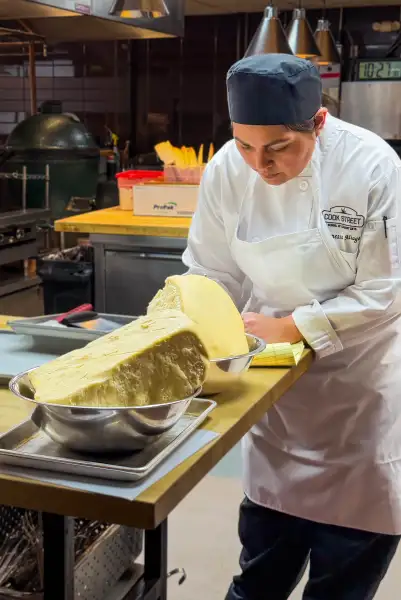
Your instructors are working chefs, and your class is capped at 20 — small enough that they know your station, your strengths, and what you need to work on. And when you’re ready for the industry, you won’t be alone: we work with every student on résumé development and job placement support, during the program and after graduation. We can’t guarantee you a job — no honest school can — but our chef instructors’ connections across the Denver Metro dining scene are real, and they use them.