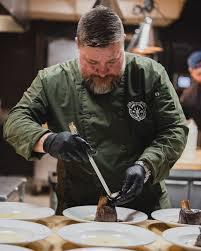
Tagged Out Kitchen - Bringing Culinary Craft to the Wild Game Table
Like many Cook Street students, chef Lance Lewis didn’t follow a traditional path into the culinary world. He entered Cook Street in his early 40s, with no prior professional kitchen experience. But as a lifelong hunter and outdoorsman, he knew he wanted to bring culinary technique to the world of wild game.
After graduating from Cook Street’s professional program in 2017, he’s filled that niche as the founder of Tagged Out Kitchen, a culinary event company that blends hunting with hands-on butchery and cooking education focused on wild game. This unique approach has been featured in Forbes, Food & Beverage Magazine, and Shoutout Colorado, earning praise for making wild game accessible to modern, sustainability-minded hunters.
He’s also a vocal advocate for responsible hunting practices, particularly in a region like Colorado where game populations face increasing pressure from human expansion and predator reintroduction.
Chef Lewis recently reconnected with the Cook Street team to discuss how he started his business, and what he’s been up to since his graduation.
What is Tagged Out Kitchen?
Tagged Out Kitchen is a culinary event company focused on wild game experiences. So whether you want a personal chef or a catered event, we can do that. I also work with different hunting guides and outfitters to put on actual hunts, which is basically like Cook Street with hunting, if you think of it in its simplest terms.
How did you get into this?
I graduated from Cook Street in 2017, and came on as a chef instructor helping the butchery classes. I noticed this theme of guys taking classes to learn how to butcher wild game rather than a whole hog. So I got hired by another place doing hunts/classes, but they didn’t bring the experience of Cook Street. They were teaching crock pot dishes and the same ol’, same ol’ wild game dishes everybody’s had before. I wanted to do something different, and bring the true culinary experience to the wild game genre. And right now in the outdoors industry, the two fastest growing segments are health and cooking, especially in Colorado.
What’s your culinary background?
I entered the game late, which is why I was looking for a lot of different ways to get into the industry. It's a young man's game. I was like 42 or 43 when I graduated. I'm going to be 52 in a couple of weeks. Now I enjoy cooking and I enjoy sharing my knowledge. I enjoy teaching people new skills. But to go into a busy kitchen on a Friday…
Are you a hunter first, or a chef first?
I would say a hunter first. But that also has been part of what's fueled my love of food, right? I grew up in Louisiana, we had really long hunting seasons. My dad was always part of a large hunting camp, and there were always these funny old guys that told great stories that hung around and just cooked all day. It's part of the culture. So I always appreciated that part, and I think that they really do go hand in hand.
What’s the spectrum of game that Tagged Out Kitchen focuses on?
Mostly white tail deer, wild hog in Texas, that sort of stuff. I think primarily what I try to focus on is the butchery side of things. If you're lucky enough to harvest an animal, you're sitting over it with a knife in your hand going “Now what?” Basically, what I try to teach is seam butchery to identify the muscle groups, follow the seams.
So you're connecting the primal purpose of hunting as a food source to not only butchering, but also in the preparation?
At the end of the day, you've taken this animal's life, right? As a hunter, I have one job, and that is to make sure this animal only has one bad day. If I can dispatch this animal as cleanly and as fast as possible, and not let the meat sit in my freezer for three years… That's my job. And on top of that, it’s some of the healthiest protein on Earth. It's the OG organic food.
What do people need to know about cooking with wild game versus the meat they get at the grocery store?
The big thing is they've got to learn proper preparation. So many of those offputting gamey flavors that people talk about as to why they're not a fan of wild game, are really just from mishandling and not knowing what to keep and what to take away. If you cut a gland, then it affects the taste of the whole animal. So proper harvest is first.
Another thing is silver skin, which is all the little facial material that's on the outside of each one of these muscle groups. If you cook with that stuff on, that's where you're going to get these gamey flavors. And you have to be cognizant of fat. Venison fat is good for making soap and candles, but other than that it imparts no flavor. If anything, it just creates a bad oil film in your mouth. So you have to get a little creative with how you're going to incorporate fat.
Another thing you need to keep in mind is, how well can you cook it, right? So typically, I try to tell people if it has a hoof, cook it medium, but if it has a foot, cook it well. Typically things with feet are predators. For instance, bears or raccoons. Any of these animals that eat other meat, they are prone to develop trichinosis and that sort of stuff, which means you have to cook that stuff well to cook those sorts of things out.
What is the hardest game to prepare?
Bear. About the only thing you can do with bear is just make sausage with it. The consumption of undercooked black beer is the number one cause of trichinosis in the United States and Canada. I mean, you have to cook the bejesus out of it, like pork chops in the 80s.
What about wild bird?
One of the things I came up with was almost like a play on a jambalaya, except I take barley and pheasant, primarily pheasant legs and thighs, and cook that down in half chicken stock and half Riesling. Typically, those things that have little funky flavors, you have to get pretty creative, and you don't want to hide it entirely. But you also want a good supporting cast.
How would you say your experience with Cook Street has helped you develop and accomplish your goals?
Cook Street taught me to think like a chef. Before attending Cook Street’s Professional Program, I often tackled ambitious culinary projects with mixed results. I’ve never been one to follow recipes to the letter. I had good instincts, but I lacked a solid understanding of the science behind flavor and how to balance it.
Through my training at Cook Street, I mastered those fundamentals. I not only gained a deeper understanding of recipes, but also developed the knowledge and technique to confidently create my own.
Another essential part of my education at Cook Street was learning how to set myself up for success in the kitchen. From mastering mise en place and knife skills to understanding a wide range of cooking techniques, I became far more efficient and confident in my workflow.
This skill set is more important than most people realize. The kitchen is a constantly changing environment, and no matter how well you prep or plan, something will inevitably go wrong. Knowing how to adapt and recover is critical. When you’re cooking in front of others—especially in a teaching role—efficiency and confidence are essential.
–
Chef Lewis is returning to the Cook Street kitchen to teach a series on using the Big Green Egg, focusing on traditional BBQ techniques. More details on that class here.
Interested in turning your culinary dreams into a career that fits your passions and lifestyle. Explore the Cook Street School of Culinary Arts Profession Program, offering an accelerated culinary education with both daytime and evening sessions.
